-->

Friday, November 4, 2011

What was your favorite book as a child?

I asked the people in our office "what their favorite book was as a child and why?"

Cassi- I loved reading Go Dog Go! By Dr. Suess because I could actually read( memorize) the words.  I also loved We’re Going on a Bear Hunt by Michael Rossen because my dad would act it out the story with us

Deborah- I loved Velvetine Rabbit and The invention of Hugo Cabret because I loved looking at their illustrations.  


Barbara- I loved reading Madeline, Chicka Chicka Boom Boom, Alexander and the Terrible, Horrible, No Good, Very Bad Day, with my children. Madeline was actually written by a Father in France who wrote the books for his daughter. My daughters loved Egyptian/Native American stories of Cinderella and Sarah and the bear (based on a true story).


 Robin- My children and I loved reading Rag Coat and We're Tired             of  living in a House


Wednesday, November 2, 2011

Playgroup: Happy Halloween!! Crafts and Snacks

Happy Halloween Faithful Readers! 
Since this last week was Halloween, instead of just one craft, we did MANY crafts!
We colored Jack-o-lanterns and glued on their faces, made Tootsie Pop Ghosts, Spiders and Webs, and Marshmallow Mummy Treats!

Here's what You'll Need and What to do for each:
Jack-o-Lanterns:
-A pumpkin drawing (you can find templates online or just draw one yourself)
-Black Construction Paper
-Scissors
-Crayons
1) Cut Construction paper into triangle and mouth shapes for jack-o-lantern's face
2) Allow child to color pumpkin (while you cut), then help child glue the face on 

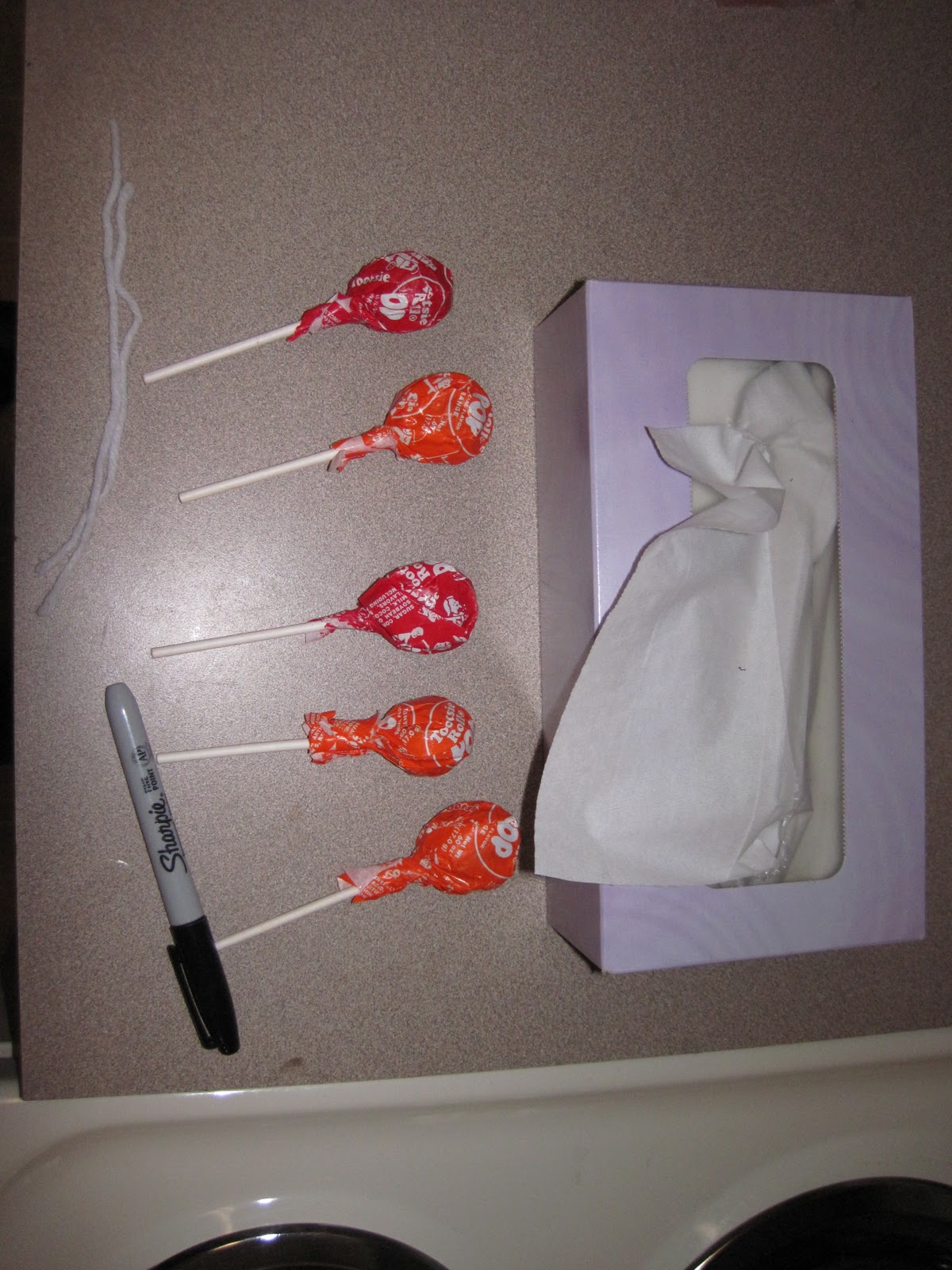
Tootsie Pop Ghosts:
-Tootsie Pops (or similar lollipop candy)
-Tissues
-Permanent Marker
-White Yarn
1) Use 2-3 tissues and cover Tootsie Pop
2) Tie yarn around neck of ghost
3) Draw eyes and mouth of ghost with Sharpie

Spider Webs and Spider:
-Black and White Yarn
-Fast Drying Glue
-3 Popsicle Sticks
1) Glue 3 popsicle sticks together as seen in picture above
2) Use White Yarn to weave around sticks to create a web
3) Take black yarn, fold 3 times (so there are 4 strands of yarn)
4) Cut yarn and tie in a knot, then cut the folds to create legs (the spider should have 8 legs)
5) glue the spider on the web and hang to decorate!

Marshmallow Mummies:
-Marshmallows
-Raisins
-Scissors (cooking ones work best, or make sure you wash them before use)
-Twizzlers or Candy Corn
1) Cut 2 slits into marshmallow
2) insert 2 raisins in one slit for eyes
3) cut a piece of Twizzlers off and insert in other slit for tongue
4) Eat and enjoy!
5) I have seen these placed on cupcakes to make an exciting decorative treat!

 Below are some Pictures of the Fun Costumes we had at Play group this week:
Cowboys:
Frog Prince:
Here's all of us after Crafts and Snacks! (we had a Fairy and Devil costume too!)
See you again next week!!

Monday, October 31, 2011

Emotion Coaching

Emotion Coaching is being able to teach your children to understand their emotions and teaching them appropriate ways to handle or express them.  Emotions Coaching includes teaching your child to communicate their emotions, teaching them to skills to calm themselves, how their emotions lead to actions, and empathy.  Children look to their parents for comfort and strength, its important to give them the love, attention and understanding needed when they are sad or frustrated.  Here are 5 basic steps from Dr. Gottman to help you become an emotional coach.

Photo Credit
STEP 1: Be aware of your own feelings so that you can better understand and explain what your child is feeling
  • When appropriate, share your emotions with your child
  • Children are learning about emotions by watching how you show yours
  • Listen to your child for clues about what she is feeling
STEP 2: Connect with your Child
  • Take your child's emotions seriously
  • Be willing to understand your child's perspective
  • Encourage your child to talk about feelings
STEP 3: Listen to your Child
  • Listen to your child in a  way that lets her know you are paying attention
  • Try not to judge or criticize emotions that are different from what you expected
  • Research shows that it is important to understand the emotion before you give advice on the behavior
STEP 4: Name Emotions
  • Start identifying emotions even before a child can talk
  • talk about emotions like happy, sad, and angry and when people feel them
  • Name a range of emotions.  Talk about what these emotions mean and when people feel them
  • avoid telling children what they ought to feel--try to identify the emotions they are feeling
  • Model identifying your own emotions--children learn by watching and copying what adults do.
STEP 5: Find Solutions
  • When children misbehave, explain why their behavior was inappropriate or hurtful
  • encourage emotional expression, but set limits on behavior
  • Help children think through possible solutions
Life Application:

I chose this topic because I related to it.  Looking back, my parents had to use emotion coaching on me a lot when I was a child.  The most common emotion I had was crying.  I cryed when I was sad, frustrated, upset, mad, scared... This could have been because of my many fears and anxieties I had.  For one thing, I was very shy so whenever I was going to a party or to school or to any social situation I was nervous and if my anxiety built up enough I would start crying making it so I couldn't go to the party or other activity.  Once I started to cry I started to cry harder.  My Mom actually helped me understand that Icried harder because I felt embarrased or frustrated with myself for crying and so I would cry even more.  When it was ok (I wasn't in a public place), my parents would just let me cry becasue they realized that my crying was my way of letting out my frustration.  They would also never belittle my feelings (even though it was probably silly what I was crying over) and they always sit next to me asking me to tell them what is wrong, waiting patiently until I was ready to talk.  If I couldn't explain my emotion, they would ask, "are you feeling this way because..."  When finding solutions, it was really helpful when my parents were able to relate to what I was going through.  If my crying lasted too long or too often, or I was making a scene in the public park my Mom would tell me to "stop crying". It may have taken a few times but I forced myself to try to stop crying (exercising mind over matter) especially so I would learn to handle my emotions in certain situations. Through this exercise I was able to hold my emotions to myself (during school so I wouldn't embarrase myself) until I got home because my parents taught me that home was a safe place to share my emotions.      

Your going to find that every child is different and so will have different emotional needs.  Hopefully my storytelling was helpful and these steps and serve as a helpful outline for you. 

Friday, October 28, 2011

Everyday Fun with Literacy

Photo Credit
You can help your preschoolers become ready to read by encouraging them to see themselves as readers when they identify letters or words, draw and label pictures, or recognize symbols, like stop signs.  Everyday, you have opportunities to help your child enjoy being a beginning reader. Here are some ideas.

At Home

  • Watch storytime together, and talk about it afterward.
  • Put magnetic letters on your refrigerator for children to play with. You can also cut letters out and post them with tape on the refrigerator.
  • Post invitations, announcements, and simple labels where children can see them.
  • Make pictures of favorite foods and label them.
  • Let your child see you use recipes. Point out words to them.
  • At snack time, make words out of finger foods such as alphabet soup, or letters with finger foods such as cereal pieces.

In the Neighborhood

  • Look for letters that children know on signs or license plates.
  • “Read” street signs together.
  • Notice and talk about billboards you see.

Visiting Family or Friends

  • Before leaving, draw a map and mark your route.
  • After the visit, have your child sent a thank-you note or picture that he or she has drawn.

At the Grocery Store

  • Create a shopping list with your child.  Items can be written or drawn.
  • Have children identify product names that they know.
  • Photo Credit
  • At the beginning of each aisle, pick a letter of the alphabet to look out for.  Count the number of times you see it an aisle.

At the Park

  • Draw letters in the dirt or sandbox.
  • Collect leaves along the way.  Then go to the library to find books so that you can identify them.
  • On index cards or squares of paper, have your child draw pictures of all the people, animals, equipment or things you saw at the park.  Write the corresponding word on another card. Turn the picture cards upside down.  Play a memory game to see how many the child remembers by showing and saying a word and asking the child to find the matching pictures.

Photo Credit

At the Library

  • Have the child spend time looking at books they have picked out.
  • Participate in a library story hour and attend the library’s other family-oriented events.
  • Get a library card for your child and check out a variety of books.

At the Zoo
  • Create a list with your child of the animals you think you will see.  You could also cut animal pictures out of magazines or draw them on the list.  Help the child cross names off the list as you see each animal at the zoo.
  • Name each animal you see.  See if your child can guess what letter the name begins with.
  • Have the child draw a picture of a favorite animal.  Hang it in a special places.

KBYU 11, Utah’s Family Station

Wednesday, October 26, 2011

Play Group Craft and Snack: Under the Sea!


This past week in play group, we read about ocean animals, made turtle rattles and ate sharks!
Turtle rattles are fun and easy to make! 
Here's what you'll need:
-Paper Plates
-Coloring materials (crayons or markers)
-Paper to make head, arms and legs (I just searched online for a template and printed it)
-Stapler/staples or tape
-Beans, rice, popcorn (anything that will rattle)

What you do:
-First let your child color the plates (shell) head, and legs of the turtle
-After they are finished coloring, put plates together and staple (or tape) around the edges, leaving a big enough hole to put rattlers in.
-Throw in a few beans or whatever will make noise and staple the rest back up.
-ENJOY!
We also ate these adorable ocean snacks:
They are pretty delicious AND easy to make!
What You'll Need:
-Vanilla Wafers
-Clear cups
-Blue yogurt or you can dye it with food coloring)
-fish fruit snacks or gummies
What You Do:
-First, crush the Vanilla Wafers into crumbs (this is the sand) and place in cups
-Then, pour blue yogurt on top
-Lastly, place fruit snack fish on top

 
Thanks for reading! See you next week for HALLOWEEN fun!