-->
Showing posts with label Reading Activities. Show all posts

Monday, September 30, 2013

Book Review: Grandfather and I by Helen E. Buckley & Jan Ormerod

photo
This is a charming and poetic book about the time a grandfather spends with his grandson.  Written in the child's point of view, the book talks about the busy and fast paced world that he lives in.  However, with his grandfather the boy can take all the time he wants and spend quality time with him.  This book suggests the importance of spending time with family and letting children be children by learning and going on adventures.

Activity:  In the book the boy and and his grandfather go on walks to explore the earth.  Take your little one on a walk and let them play and explore.  Talk to them about what they are seeing and how things work (how trees grow, look at cloud shapes, etc.)  Let them experience the world first hand and let them take the time to learn for themselves about the things they are seeing.

Friday, July 26, 2013

Book Review: Twinkle, Twinkle Time for Bed + Brush, Brush, Brush!

This is a 2 in 1 book. One side can be read while your children brush their teeth and the other can be read once they are tucked in bed. This is a book that we give out during our Ready to Learn class. One of our class topics is "Rhymers are Readers" so we use this book to illustrate that point. See if your child can find which words rhyme as you read. 


At toothbrushing time, try singing Brush, Brush, Brush! out loud to the tune of "Do Your Ears Hang Low?" It's a fun way to help toddlers develop self-help skills. And remember, a pea-sized amount of toothpaste is just right for toddlers. 


Wednesday, July 17, 2013

Playgroup Activity!

Welcome Baby helps to start new playgroups in our community. Currently we have playgroups in Orem, Pleasant Grove, and Provo. Our Provo playgroup leader is Cindy Primrose and she has done an awesome job! This past month she did an ocean themed playgroup and here's how it turned out. Feel free to recreate her ideas in one of your own playgroups. 


"Today we had an ocean theme playgroup. When the children arrived they could choose the playdough table or the water table. At the playdough table I placed shells and mermaid tears (glass beads, you can find these at the dollar store) and blue playdough ( the ocean) The children pressed the shells and mermaid tears in the dough, making interesting imprints. They also enjoyed covering the shells and mermaid tears with the "ocean" and digging them out. (This idea came from the blog Raise Up A Child)


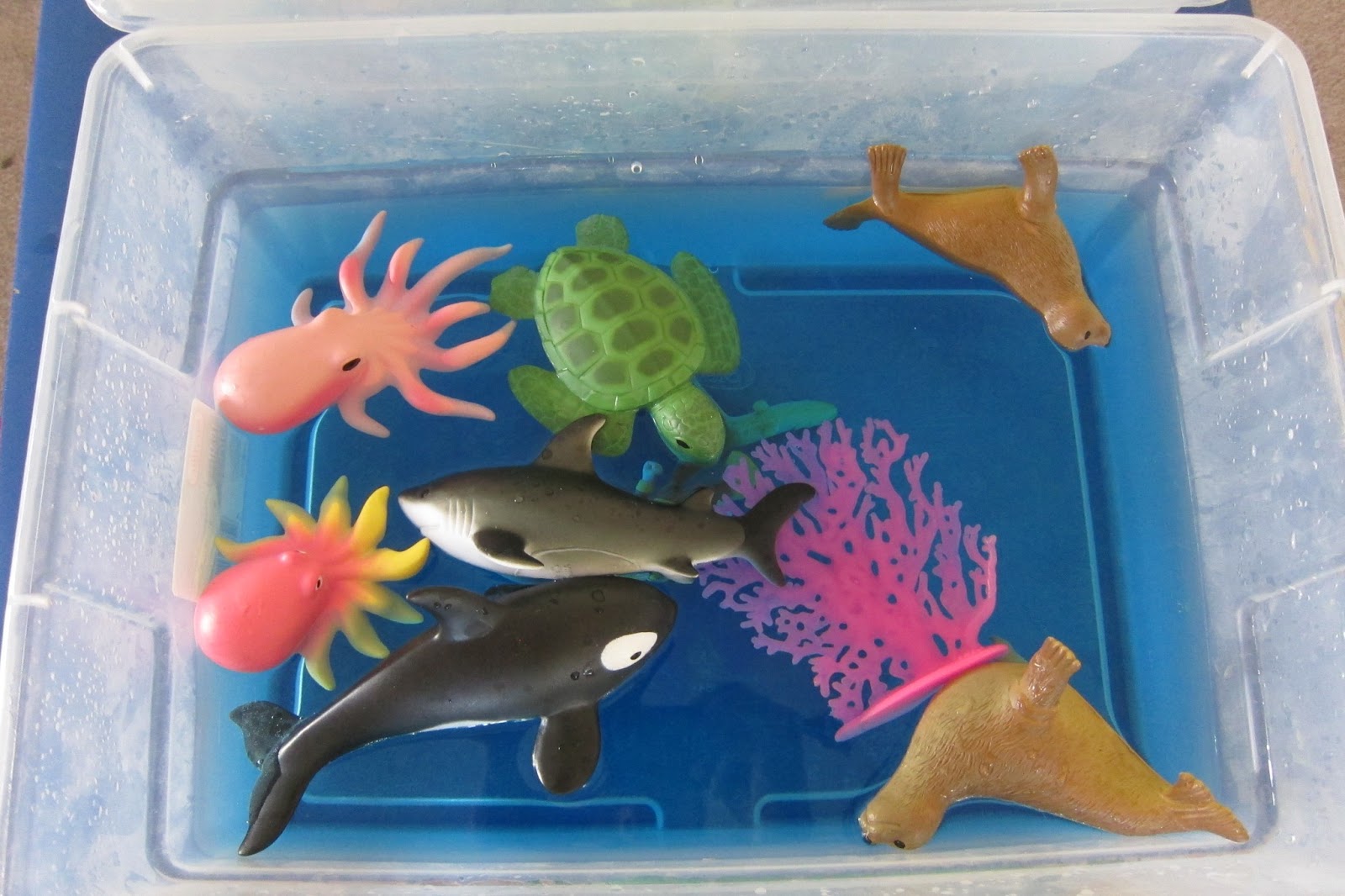
At the water table, I placed two bins filled with water. I added a few drops of food coloring to make the water blue. I put in some sea animals and some plastic coral. The children had fun splashing and letting the animals swim around. This was also a great way to introduce vocabulary.


For story time we read the book Ten Little Fish. By Audrey Wood. It is a counting book with wonderful illustrations of ocean life.


Our craft for the day was making fish. I cut fish out of white construction paper. We used  sequins, colored macaroni (put macaroni in baggies. Put several drops of food coloring on macaroni. Close bag and squish the macaroni around to distribute color. Spread macaroni on cookie sheet to let dry.) small pieces of tin foil, wiggly eyes, crayons, markers and glue, to decorate the fish. Each fish was colorful and unique. This was an easy project that worked with different age levels.


For snack we served goldfish crackers and blue punch.  Finger play idea:All the fish are swimming in the water, swimming in the water, swimming in the water.All the fish are swimming in the water. Bubble, bubble, bubble, bubble, POP!(hands swim like a fish. Make your fingers in the shape circles for the bubbles and float upward. Clap on the pop!)" -Cindy


Friday, July 12, 2013

Book Review: Baa! Moo! What Will We Do?

Photo 1
This book was written by A. H Benjamin and illustrated by Jane Chapman. Its a clever book that explains the role of each farm animal on the buttercup farm. The animals in this book start to get anxious when they hear that a kangaroo is joining their farm. They have no idea what a kangaroo does! The cow worries that the kangaroo will make creamier milk than her and the dog worries that the kangaroo will herd the sheep better than him. What will they do if the farmer likes the kangaroo better? Will the kangaroo be their friend? 

After reading this book have your child make their own kangaroo. Complete with a pouch! Print a coloring page, color the 3 different pieces and then cut them out. Attach the pouch onto the large kangaroo with some elmers glue. Only put glue on the bottom, left and right sides so the small kangaroo can fit in the pouch. Have fun!


Printable Kangaroo

Friday, July 5, 2013

Book Review: The Way I Feel by Janan Cain

This weeks book review corresponds to a post from last week on emotions.Understanding and expressing emotions as a little child is a learned skill. Children have a hard time expressing multiple emotions or going from one emotion to next in a short amount of time. This book is a great visual to help children understand their feelings and emotions. The use of colors and lines helps children understand what different feelings look like and how they can be expressed. Just looking at the artwork sparked a bit of each emotion in me. 

Click here to purchase this book on Amazon

Here is an activity to do after you read this book. It's not just a one time activity either. 


Use art to help your children express their emotions. Have your children use colors and lines to show what emotions they are feeling. Talk about the difference between jagged lines and wavy lines. What emotions might those lines represent? Discuss what light and dark colors might represent. Later if your child is misbehaving or struggling to identify their emotions, let them try drawing or pointing to how they feel. 


silly line


sad line


Friday, June 28, 2013

Book Review and Activity: Chicka Chicka Boom Boom by Bill Martin Jr. and John Archambault

This book is a classic! Its a fun book to teach children about the alphabet but it also is full of rhyming and repetition. The entire alphabet climbs up the coconut tree in this book but "Chicka chicka boom boom! Will there be enough room?" Once all the letters make it to the top the tree is too full and Chicka chicka boom boom! they all come crashing down. 


Photo 1

After reading this book make some tambourines with your child. You'll need some durable paper plates, a stapler, crayons or markers and some dried beans. Have your child color each side of the plate using pictures from the book. Add some beans between the two plates and staple them together. Then try reading the book again but have your child shake the tambourine whenever you read the words chicka chicka boom boom! 


Your child may want to shake their noisy tambourine throughout the entire book so before you begin reading start my giving them a sign that means "keep your tambourine quiet". Something like touching your nose or putting your hands behind your back. This is something you can use while reading the story. This will teach them to pay attention, listen and be patient. 


Tuesday, June 25, 2013

Resource Spotlight: KBYU Eleven - ENTER TO WIN TICKETS TO THE DEER VALLEY MUSIC FESTIVAL

"KBYU Eleven, a local Utah television station, is a great resource for parents and all of those who are helping raise a child.  KBYU Eleven includes quality educational television programs, a safe online environment, and video parenting workshops."

KBYU 11


KBYU offers a kids and family section online where TV program schedules are located along with corresponding educational activities and reading resources. This section also includes a 12 video workshop for parents that teaches them how to prepare their children for school and successful learning (READY TO LEARN). Another section that KBYU offers on their website is a community section where resources, events and contests can be found. 

Speaking of contests...check out the Utah County Moms Blog to enter a contest to win 2 free vouchers to this years Deer Valley Music Festival! Click here for more information and to enter. The Festival is Saturday June 29th and the contest ends this Friday June 28th. 


Deer Valley


Music Festival 2011

Friday, June 21, 2013

Book Review: Smiley Shark by Ruth Galloway

Click here to purchase this book at Barnes and Noble


Smiley the shark wants to play with all of his other ocean friends but once he finds out that his smile actually frightens the other creatures he doesn't feel like smiling anymore. His smile later saves his friends from a dangerous situation and he realizes that his smile is special. After reading this story make your own smiley shark like the one below! Put the smiley shark in a place where your child will see it (maybe on the bathroom mirror or on the ceiling above their bed so they'll see it when they wake up). Do this as a reminder for them to SMILE and be HAPPY!

Click here for a printable shark page

Friday, June 14, 2013

Book Review: Bear's Loose Tooth by Karma Wilson & Jane Chapman

Purchase this book on iTunes by clicking here
 Bear is enjoying a nice lunch with all of his friends when he finds something wiggling in his mouth. What could it be? His first loose tooth!! 
Purchase this book on amazon by clicking here. 

After reading this story, try this fun Loose tooth activity. Using pink construction paper cut out some lips. Glue each lip to a popsicle stick and write your child's name on it. Use mini marshmallows or pieces of white gum as teeth. If you lick the mini marshmallows the sugar will act like glue and stick to the construction paper. If you want to use gum or another white candy you'll have to stick them on with hot glue or another adhesive. Have your child count how many bottom and top teeth they have. Then have them count and place the same number of marshmallows on their lips. If they have a tooth missing make sure to leave a gap on their lips. I'd suggest writing the date on the back so you your child can see the changes their teeth have made over time. 

Photo 3


Friday, June 7, 2013

Book Review: Corduroy by Don Freeman

This is a book I remember reading often with my Dad. The pictures are great and the story is cute and exciting. Corduroy the stuffed bear lives on a shelf in a department store. One night after the customers have gone, he realizes he has lost a button on his overalls. The search begins for corduroys button but just when he's given up on finding it a small girl purchases him and well...you'll have to read the rest to find out what happens. 


Photo 1

Find this book in your local library or purchase it on amazon. After reading this book teach your child to sew large buttons onto a plastic canvas. 


Photo 2


 Here's what you'll need:


  • Shoelaces or any other kind of string
  • Large craft buttons with holes big enough for a shoelace/string to go through
  • plastic canvas-you can purchase this at your local craft store. 

Friday, May 31, 2013

Book Review: Frederick by Leo Lionni

This book is an adorable story about a poet mouse who uses his words to warm his friends during the winter months.  The author uses expressive words to describe the story and beautiful collage artwork throughout. This book also won a Caldecott Honor award and the Times Best Illustrated Book award.  

Photo 1


After reading the book talk to your children about work and the value of work.  Was what Frederick did considered work?  Did he contribute to his community?  Do all members of a community have to contribute equally?  

As an activity have children create their own collages using cut up pieces of construction paper glued to card stock.  


paper-collage
Photo 2
 

Friday, May 24, 2013

Book Review: The Wind Blew by Pat Hutchins


Last week at our monthly Ready to Learn class we talked about the building blocks of emergent literacy. These building blocks include listening, talking, writing, decoding and comprehension. Part of learning comprehension is sequencing. This includes questions like, what came first? What came after and what can you expect next? Watch this video to understand more on how to help your child build their literacy skills. To receive information and an evite to our Ready to Learn class email us at baby1@unitedwayuc.org


Photo 1
The Wind Blew is a must find in your local library. Not only are the illustrations beautiful but this story helps your child learn sequencing. After reading this book print the activity page below. Cut out the following items, color them and then use a paper clip to attach them to a piece of yarn or string. Have your child place them in the order they appeared in the story.


Activity Page

Friday, May 3, 2013

Book Review: Bubble Bubble by Sesame Street Workshop

"Reading to your child helps them become ready to start and stay in school. The fun doesn't have to stop when the reading is done! There are many skills that can be initiated from reading a book. To build upon these skills, use activities to reinforce the learning." 
 School age: Infant

Developmental Skill: Gross Motor skills target the large muscle groups such as arms, legs and torso. Develop these skills by jumping, throwing, running and kicking.

Activity: Have your child touch his/her body parts that they mention in the story. Make your own bubbles and have your child learn to blow through the wand, then have your them chase the bubbles. If it is a cold day use the bathtub as a place to blow bubbles.


Monday, April 29, 2013

Books are the Key to Life Long Learning


Shared Reading

Shared reading involves either reading aloud to children or having older children read aloud to you and taking time to talk about the characters, plots and morals of the stories you have read. Jim Trelease, expert in child literacy said, "The single most important activity for building the knowledge required for eventual success in reading is reading aloud to children." Source

Rhymers are Readers

Research has shown that Nursery Rhymes are extremely important in a child's development. Experts in literacy and child development have seen that if children know eight nursery rhymes by heart by the time they're four years old, they're usually among the best readers by the time they're eight. [Fox, M. (2001). Reading Magic. San Diego, CA: Harcourt.] When children hear nursery rhymes, they hear the sounds that vowels and consonants make and learn how to put them together as well as practicing pitch, volume, voice inflection and rhythm of language. Since nursery rhymes are patterns, they help children learn easy recall and memorization. Children also develop their mouth and tongue muscles by using different sounds in rhymes. 

Mother Goose Rhymes:
     Link 1
     Link 2

Photo
Activities and Ideas

Make Predictions. As you read a story, ask your child what he or she thinks is going to happen next. After the story is over, ask you child if he or she can think of a different way the book could have ended. 

Go on a reading campout. Build a tent in your living room or backyard. Ask your child to bring his or he favorite books and stuffed animals. Grab some flashlights and read together. 

Find a recipe online or in a cookbook. Read the recipe out loud together and follow the instructions to cook something delicious. 

When you open a new board game, read the instructions with your child. 

Have a reading scavenger hunt. Choose a letter of the alphabet and talk about the sounds it makes. Go on a walk around your house or neighborhood and find as many things as you can that start with that letter.

Make your own book. Using photographs and your child's drawings, make a picture book together. Write the words to the story and then read your book together.

Put on a puppet show. Choose one of your child's favorite books and read it together. Then make puppets out of socks or brown lunch bags. Act out the story for family or friends.

Pause as you are reading a book to talk about how the characters may be feeling or what they could be thinking.

Let children pick their own books. Don't worry if they choose the same one over and over. It takes an adult six times to recognize a word; it takes even longer for an infant or toddler.

For babies to toddlers use facial and vocal expression as you talk and play with your child. When repeating rhymes or fingerplays, let children act them out as you say them.

For toddlers, 2-4 years old, help them use all of their senses during an activity. For example, if you go for a walk, have them listen to the sounds outside and feel different objects. Ask them open-ended questions about what they are seeing and feeling. When reading rhyming books, pause to let the child finish the word and tell the story.

When your children are older (4-5) let them hold items and be in charge of activities. Use different materials, such as dress-up clothes, puppets, and pictures to retell a child's favorite stories.


These ideas and activities are available HERE

Friday, April 26, 2013

Book Review: The Giving Tree by Shel Silverstein

"Reading to your child helps them become ready to start and stay in school. The fun doesn't have to stop when the reading is done! There are many skills that come can be initiated from reading a book. To build upon these skills, use activities to reinforce the learning."


Book Review: "It has been said that the true example of love is being willing to give of one’s self for the benefit of another. Shel Silverstein tells the story of love between a boy and a tree that is an example of this sacrificial love. From the time the boy is young and needs shade as he plays to growing up and being allowed to climb in her branches to the time when he is older and wants something that may mean the end of the tree, the tree keeps on giving to him- out of love. Though there are many ways to interpret this story, the true message of love shines through. Even when the boy is an old man and long after the tree has been cut down, what is left of the tree is still giving. The old man, once the little boy who played under the tree, now uses the stump of the tree to rest on."

Activity: From the book message, children learn that planting seeds is giving to others. After reading this with your child talk about why the tree would want to give itself away. Discuss how it feels to give something and the feeling of receiving gifts. Supply a bag of apples and cut one apple in half horizontally. Have your child gather seeds from the apple. 

Make a treat using the apple as the main ingredient. Ask what trees give to the world and how planting each apple seed gives back to nature. Plant a tree or small plant, even though it is a slow process. 

Sources:
Link 1
Link 2

Friday, April 19, 2013

Book Review: Caps for Sale by Esphyr Slobodkina

"Reading to your child helps them become ready to start and stay in school. The fun doesn't have to stop when the reading is done! There are many skills that come can be initiated from reading a book. To build upon these skills, use activities to reinforce the learning."


Review: Caps for Sale is a timeless classic, in print for over fifty years, and beloved by generations of readers. This easy-to-read story about a peddler and a band of mischievous monkeys is filled with warmth, humor, and simplicity. Children will delight in following the peddlers efforts to outwit the monkeys, and will ask to read it again and again.

Activity: At HomeSchool Creations website in the Preschool Corner there is a free activity packet to go along with Caps for Sale. LINK


A free Tree template to use for an activity

LINK


Wednesday, April 10, 2013

Playgroup: The Very Hungry Caterpillar Activities

"Eric Carle's modern classic, The Very Hungry Caterpillar is complete in every detail, following the ravenous caterpillar's path as he eats his way through one apple (and the pages of the book itself) on Monday, two pears on Tuesday, three plums on Wednesday, and so on, through cherry pie and sausage--until he is really fat and has a stomachache. And no doubt you know what happens next! Kids love butterfly metamorphosis stories, and this popular favorite teaches counting and the days of the week, too." -Karin Snelson
This story is a great representation of metamorphosis that occurs in springtime. There are several activities you can do with your kids relating to The Very Hungry Caterpillar.

Vocabulary learned from this story: 
    • Food items
    • Numbers
    • Days of the week
    • Colors

Math-Sequencing Activities


Color Activity


Food Activity

Hand Painting


Tuesday, April 2, 2013

Resource Spotlight: Everyday Learners of Utah County

Education matters. And you can help. 


In 2010 Three out of Ten Third Graders in Utah County were not Reading at Grade Level.

That means that by 2019, 2,500 students in Utah County are more likely to drop out of high school. Read more...
 
What's the Solution?
 
YOU ARE. And now, United Way of Utah County invites you to lend a hand to the cause of education by counting yourself as an EveryDay Learner.
 
What is an EveryDay Learner?
 
By 2014, United Way of Utah County plans to have 10,000 residents of Utah County counted as EveryDay Learners. An EveryDay Learner is simply someone who makes education a priority in their life. That might mean an extra hour a week doing formal volunteering such as reading, tutoring or mentoring. But it might also meanadvocating for education in ways that take little to no extra time.
 
The Benefits
 
However you choose to get involved, by counting yourself as an EveryDay Learner you are showing support for the important cause of education. You will also receive a monthly newsletter with activity tips and ideas on what others are doing to be EveryDay Learners.
 

ACT NOW. Stand up and be counted. Be an EveryDay Learner.


Friday, March 29, 2013

Book Review: The Country Bunny and the Little Gold Shoes by Du Bose Heyward

"Reading to your child helps them become ready to start and stay in school. The fun doesn't have to stop when the reading is done! There are many skills that come can be initiated from reading a book. To build upon these skills, use activities to reinforce the learning."
Age: 4+

Written in 1939, the story illustrates of a young lady bunny whose dream is to become one of the five Easter bunnies. Her dream slowly disappears after marriage and having 21 children. In the end, it's her skills in successfully raising those children that allow her to reach the desirable position. The story, which teaches that kindness and wisdom can trump size and strength lends itself well to many activities!

Art Activity: There are many creative activities to go along with this story, such as when a sick little boy gets the prettiest Easter egg, which "glitters like a diamond." Decorate elaborate Easter eggs on card stock using paint, glitter, sequins, ribbons, stickers, fabric scraps, etc. Or make a paper chain of 21 bunnies and decorate their tails with cotton balls.

Bunny templates:   Link1    Link2

Story Skills: Ask your kids why the mother bunny is given the gold shoes. Point out that the grandfather bunny doesn't say why he chose her, but you know anyway because of what happened in the story. Then ask the kids what the magical property of the gold shoes is. Point out that the author shows the reader instead of telling what the gold shoes do. Have your kids find other instances in the story where the author shows rather than tells.

Friday, March 15, 2013

Book Review: Have You Seen My Duckling? by Nancy Tafuri

"Reading to your child helps them become ready to start and stay in school. The fun doesn't have to stop when the reading is done! There are many skills that come can be initiated from reading a book. To build upon these skills, use activities to reinforce the learning."

School age: Infant+

Book Review: An anxious mother duck leads her brood around the pond as she searches for one missing duckling.

Developmental Skill: Imagination is foundational skill for children to develop problem solving, independent thinking and creative thinking. Imagination is an important part of play where children can understand the world around them.

Activity: Have your child look for the duckling that is hiding; after reading the book several times have your child look and find the turtle. You can also play peek-a-book with your child and have fun finding each other.